Premature valve failure is one of the most expensive problems in artificial lift operations. When a traveling or standing valve in a sucker rod pump leaks, production drops immediately — and every workover job to pull the pump out of the hole can cost tens of thousands of dollars. In most cases, the root cause is not the pump itself, but the wrong selection of the API 11AX ball and seat inside the pump barrel.
This guide explains how to select the right tungsten carbide valve ball and seat combination for your subsurface pump — covering binder materials, hardness grades, tolerances, and downhole conditions — so you can extend pump check cycles and reduce workover frequency.
What Is an API 11AX Ball and Seat?
API Spec 11AX is the American Petroleum Institute standard governing subsurface sucker rod pumps and their fittings, including valve balls and valve seats. Within the pump, the ball and seat act as the intake and discharge check valves: the ball lifts to let fluid pass, then seats back to hold the fluid column as the plunger strokes.
Because these components work under high hydraulic pressure at depth, their service life depends on two things: correct material selection and precise geometry. A perfectly lapped seat with the wrong binder grade will fail in a sandy well just as quickly as a good grade with poor surface finish. Both factors must be specified together.
Step 1: Choose the Right Binder — Cobalt, Nickel, or Titanium
Tungsten carbide valve balls and seats are available with three common binder systems, and this choice matters more than any other:
Cobalt binder (TC-Co) — the industry default. Excellent toughness and impact resistance for high-load, general service wells. Best choice where abrasion is the primary wear mechanism and corrosion is mild.
Nickel binder (TC-Ni) — the standard recommendation for sour service. In wells containing H2S and CO2, cobalt binder is vulnerable to galvanic corrosion and hydrogen embrittlement. Nickel-binder seats maintain structural integrity where steel and cobalt grades fail prematurely.
Titanium binder (TC-Ti) — for severe combined wear-and-corrosion duty, offering improved performance in highly corrosive, high-solids environment.
Step 2: Specify Hardness and Grade
Most oilfield valve balls fall in the HRA 89.5–91.0 range, balancing hardness against transverse rupture strength (TRS). A higher hardness improves abrasive wear life in sandy wells but reduces impact toughness — a critical trade-off in wells with fluid pound or gas interference.
Request the material datasheet for each grade, including density, hardness, TRS, and porosity class. A manufacturer working to ISO and AFMBA standards will provide these figures without hesitation — if they can’t, that is a warning sign.
Step 3: Verify Dimensional Accuracy and Sealing
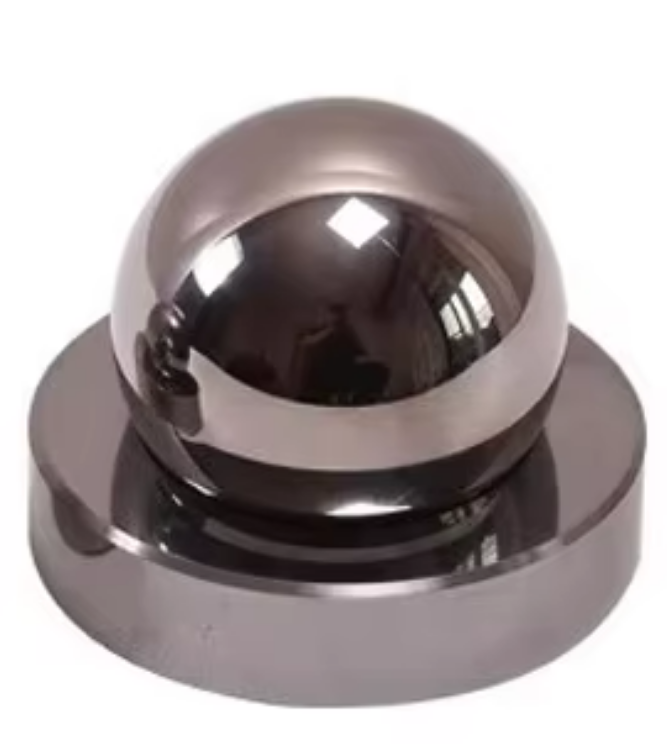
Sizes and pressure ratings covered by API Spec 11AX, with non-standard sizes available on request.
Surface finish: seats should be finished standard or mirror-lapped for positive sealing.
Vacuum testing: every ball-and-seat combination should be vacuum tested to verify a perfect seal at all contact positions before shipment.
Matched pairing: balls and seats should be supplied as verified pairs, not mixed from batch stock.
Step 4: Match the Pair to Your Well Conditions
| Well Condition | Recommended Configuration |
|---|---|
| Sandy / heavy oil | TC-Co, high hardness grade, standard finish |
| Sour gas (H2S / CO2) | TC-Ni binder balls and seats |
| Deep well / high pressure | High-TRs grade, verified pair, mirror lapping |
| CBM dewatering / ESP | TC-Ni or TC-Ti, continuous duty grades |
A Practical Checklist Before You Order
1
Confirm the manufacturer holds API certification.
2
Ask for the grade datasheet: hardness, density, TRS, binder content.
3
Specify well conditions — sand, H2S/CO2, depth — for expert recommendation.
4
Confirm vacuum testing and matched pairing on every shipment.
5
Ask whether blank and finished balls are both available.
Work with an API-Certified Carbide Manufacturer
Guanghan N&D Carbide Co., Ltd. has manufactured tungsten carbide valve balls and seats for the global oilfield sector for over 20 years, fully compliant with API Spec 11AX. Our balls and seats are Sinter-HIP sintered from virgin raw materials, available in cobalt, nickel, and titanium binder grades, mirror-lapped, and vacuum tested as matched pairs.
Need help specifying the right ball and seat for your wells? Contact our engineering team for a free grade recommendation and quotation.
Post time: Sep-15-2026


